Introduction
In the intricate world of food science and industrial manufacturing, few ingredients demonstrate the versatility of soya lecithin. Extracted from soybean oil during refining, this naturally derived phospholipid complex has evolved from a simple by-product to a cornerstone additive across global industries. Its amphiphilic molecular structure bridges the gap between oil and water, granting exceptional functional properties critical for modern production processes.
This article explores the dual, overlapping roles of soya lecithin as both a release agent and an effective wetting agent, the science behind these functions, and their practical applications across food, pharmaceutical, cosmetics, and industrial sectors.
Soya Lecithin as a Release Agent
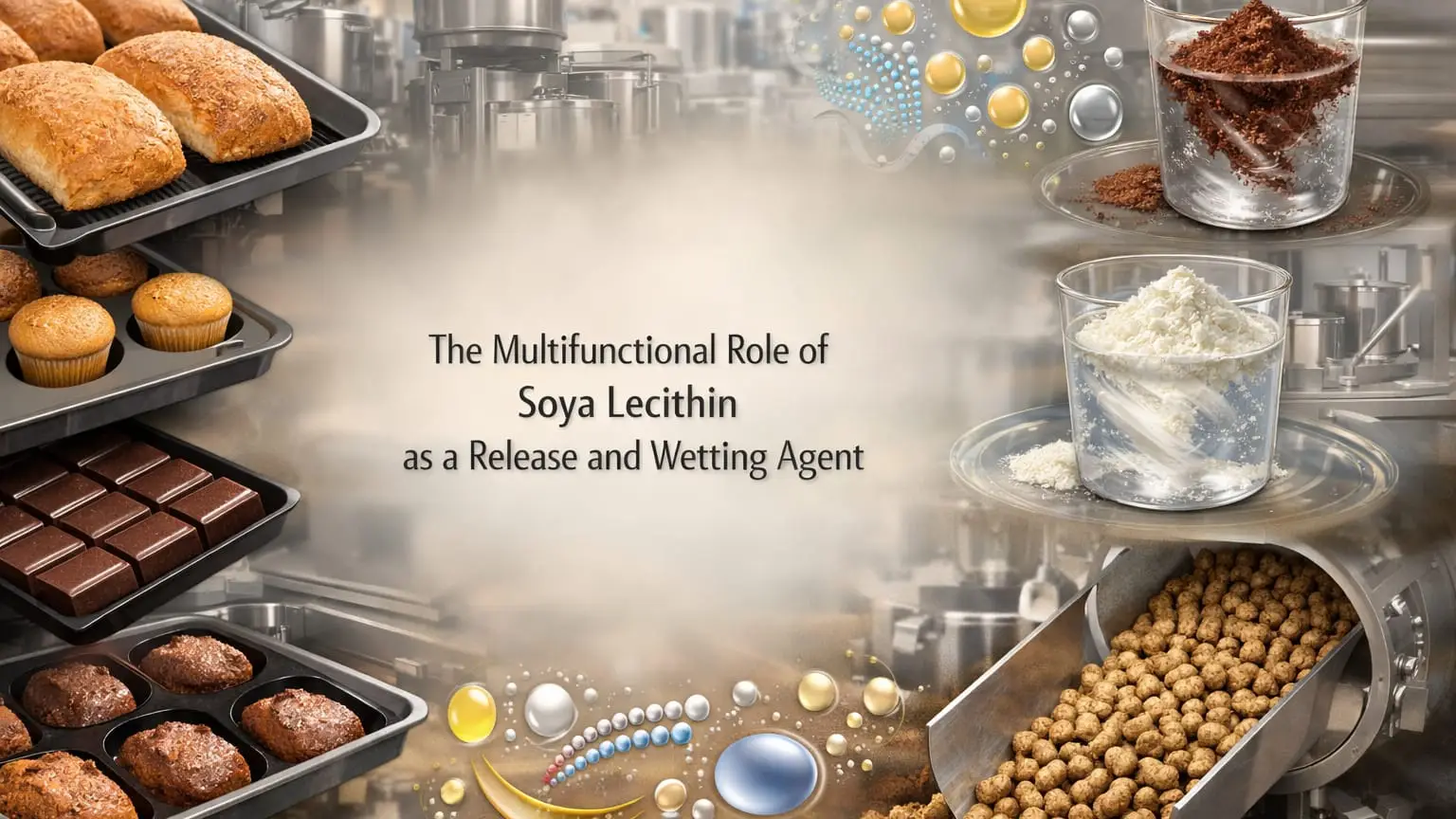
A release agent prevents products from sticking to surfaces, improving process efficiency and product quality. Soya lecithin forms a microscopic barrier on molds, trays, or industrial equipment, allowing products to release cleanly without sticking.
Key applications:
- Food Industry: Baking and confectionery, such as breads, cakes, and chocolate molds, benefit from reduced adhesion, cleaner release, and lower breakage rates.
- Industrial Manufacturing: Plastic, rubber, and composite materials utilize lecithin-based release agents for easy demolding and smoother processing.
- Animal Feed: Lecithin acts as a pelletizing aid, improving the release of feed from machinery.
Advantages over synthetic agents:
- Natural and food-grade, supporting clean-label trends
- Minimal residue, preserving product flavor and appearance
- Thin, uniform coverage without pooling, improving efficiency
Soya Lecithin as a Wetting Agent
As a wetting agent, lecithin reduces interfacial tension between liquids and solids, improving the spread and penetration of liquids across powders or surfaces. This is essential for instant and powdered food products, pharmaceuticals, and technical formulations.
Functional benefits:
- Food & Beverage: Enhances dispersibility of cocoa, milk solids, and flour in instant drinks, soups, and protein powders, ensuring lump-free reconstitution.
- Pharmaceuticals & Nutraceuticals: Improves dissolution and uniformity of active ingredients in emulsions, tablets, and liposomal delivery systems.
- Industrial Applications: Promotes even dispersion in paints, coatings, and lubricants, as well as uniform coverage in agrochemical sprays.
By improving wettability and dispersion, lecithin ensures consistent product performance, reduces processing time, and enhances end-user experience.
Applications Across Industries
Soya lecithin’s versatility spans multiple sectors:
- Food & Beverage: Acts as an emulsifier, stabilizer, and release agent in chocolate, baked goods, margarines, dressings, and instant mixes. Reduces viscosity and supports homogeneous particle dispersion.
- Pharmaceuticals & Nutraceuticals: Serves as a wetting agent and emulsifier, integral to lipid-based drug delivery systems and dietary supplements.
- Cosmetics & Personal Care: Stabilizes creams, lotions, and serums, improving oil-water compatibility and texture.
- Industrial & Technical Uses: Functions as a dispersant in paints and coatings, lubricant in textiles, and anti-stick agent in plastics and rubber processing.
The wide range of applications underscores lecithin’s critical role as a multifunctional ingredient, enhancing process efficiency and product quality.
Sourcing Quality: Specifications and Supplier Considerations
Performance varies by lecithin grade. Key factors include:
- Phospholipid concentration (Acetone Insoluble content): Higher AI indicates stronger functionality
- Physical form: Fluid for oil-based systems, powder for dry mixes, granules for specialized handling
- Processing history: Fractionation, de-oiling, or enzymatic modification affects emulsification, release, and wetting performance
Partnering with reputable suppliers ensures consistent quality, technical support, and traceable material. Platforms like chemtradeasia offer access to verified producers, and logistical support for global supply chains, enabling manufacturers to optimize formulations and ensure regulatory compliance.
Conclusion
Soya lecithin is a naturally derived, multifunctional ingredient whose ability to act as both a release agent and wetting agent makes it indispensable across food, pharmaceutical, cosmetic, and industrial applications. From preventing sticking in baked goods to enabling smooth dispersion in instant drinks, lecithin enhances efficiency, consistency, and product quality.
As industries increasingly prioritize clean-label, plant-based, and high-performance additives, understanding lecithin’s properties and securing reliable supply through platforms like chemtradeasia is key to innovation, operational excellence, and competitive advantage.
Leave a Comment