Global Soy Lecithin Market Applications & Buyer Landscape 2026
Introduction: Soy Lecithin as a Multifunctional Platform Emulsifier in 2026
Soy lecithin continues to solidify its position as a multifunctional platform chemical in global supply chains, driven by rising demand across food processing, feed formulation, and advanced industrial emulsification systems. In 2026, the market reflects a steady expansion trajectory supported by a 6.2% CAGR, with average trading levels hovering near USD 1,250/MT amid tightening soybean crushing margins. Global production is estimated at 2.8 million MT, concentrated in North America, Brazil, and China. Its versatile phospholipid composition strengthens its role as a critical bio-based ingredient enabling clean-label and high-performance formulations value chains.
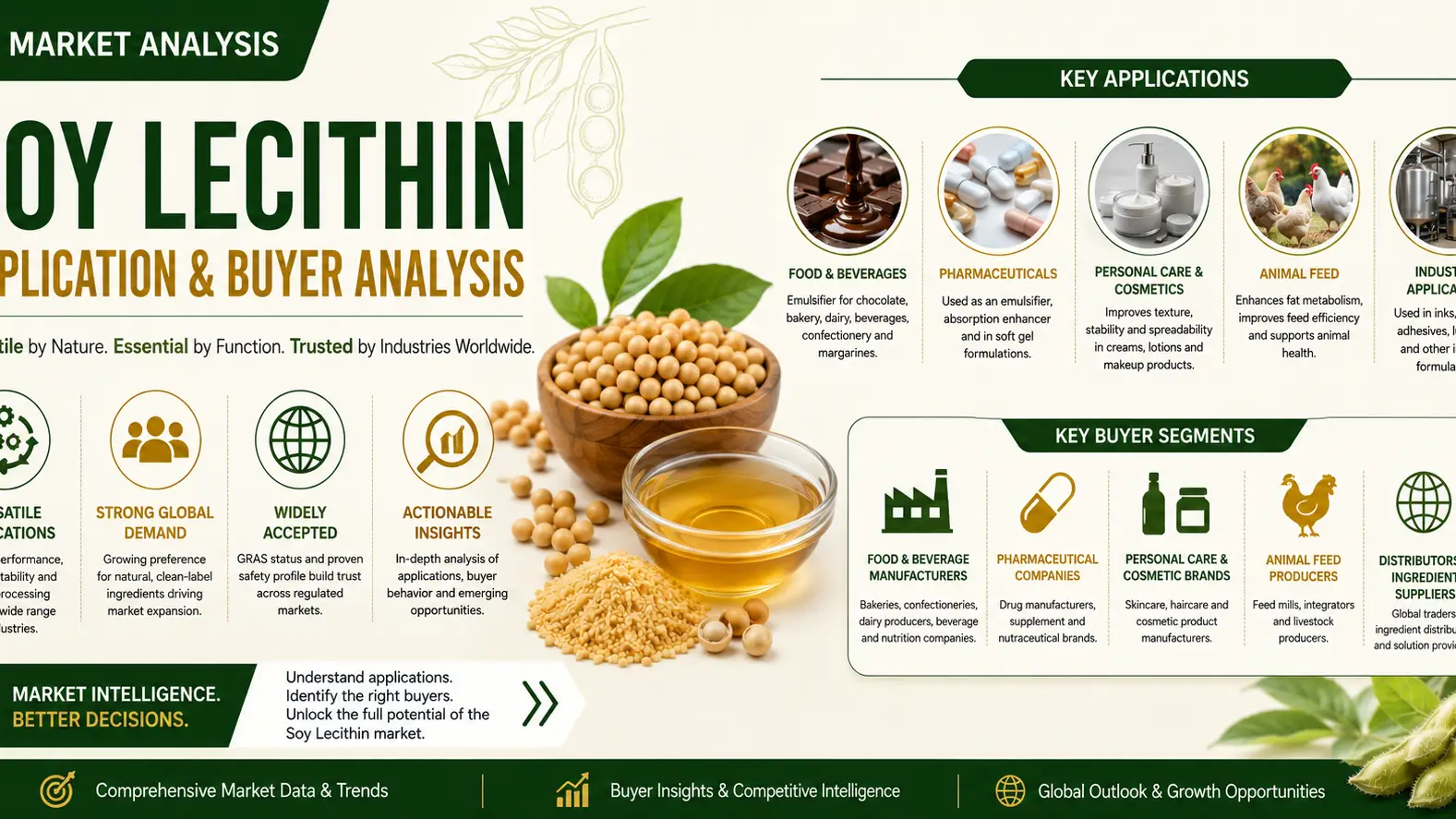
Applications in Food & Beverage Processing
Soy lecithin remains indispensable in food and beverage manufacturing, particularly as an emulsifier in chocolate, bakery, and instant beverages. In 2026, consumption accounts for nearly 38% of global demand, with functional-grade lecithin priced around USD 1,300/MT. Demand growth is reinforced by clean-label reformulation trends and increased use in plant-based alternatives, improving texture stability and shelf-life performance across processed food categories driving continuous industry innovation momentum.
Animal Feed and Livestock Nutrition Buyers
In animal feed applications, soy lecithin is valued for its energy-dense phospholipids that enhance nutrient absorption in poultry, swine, and aquaculture sectors. Global feed-grade demand represents 27% of total consumption, with pricing averaging USD 1,100/MT. Expansion in protein-intensive diets and precision livestock farming continues to elevate procurement from integrated feed manufacturers and large-scale agribusiness buyers particularly in emerging Asian livestock markets large integrated feed operations.
Pharmaceutical and Nutraceutical Applications
Pharmaceutical and nutraceutical manufacturers increasingly rely on soy lecithin for drug delivery systems and softgel encapsulation, supported by its biocompatibility and absorption efficiency. In 2026, pharma-grade lecithin commands premium pricing near USD 1,450/MT, with demand growing at above-market rates due to lipid-based formulation innovations and expanding supplement consumption in North America and Europe especially in high-value clinical nutrition and functional health formulations globally expanding demand.
Industrial and Cosmetics Buyer Landscape
Industrial and cosmetics sectors utilize soy lecithin as a dispersing and wetting agent in paints, coatings, and personal care formulations. Demand is driven by sustainability mandates and bio-based ingredient substitution, with industrial-grade lecithin averaging USD 1,200/MT. Rising procurement from multinational cosmetic brands highlights its functional versatility and compatibility with green chemistry initiatives especially across premium cosmetics, coatings innovation, and sustainable industrial manufacturing demand growth segments.
Conclusion
Overall, soy lecithin reinforces its status as a scalable platform chemical bridging food, feed, pharma, and industrial markets. With stable demand growth and tightening supply fundamentals, buyers are increasingly prioritizing long-term contracts and integrated sourcing strategies. As global value chains become more sustainability-driven, procurement resilience is critical. In this context, Tradeasia International emerges as a reliable partner, offering consistent supply access, technical support, and global logistics integration for industrial buyers seeking efficiency and stability in lecithin sourcing networks reinforcing long term supply security across global commodity chemical markets framework stability.
Sources
Leave a Comment