Introduction
Sodium Sulphate Anhydrous Feed Grade is increasingly positioned as a versatile platform chemical across industrial processing chains, supporting applications in detergents, glass manufacturing, pulp and paper, and specialized feed formulations. As of 2026, the global market is characterized by steady expansion driven by downstream chemical integration and cost-efficient bulk material demand. The sector records a projected CAGR of 4.2%, with global production volumes approaching 6.5 million MT, while average trade prices remain within USD 120–180/MT, reflecting moderate but stable commodity pressure across regions.
Industrial Applications in Feed and Chemical Sectors
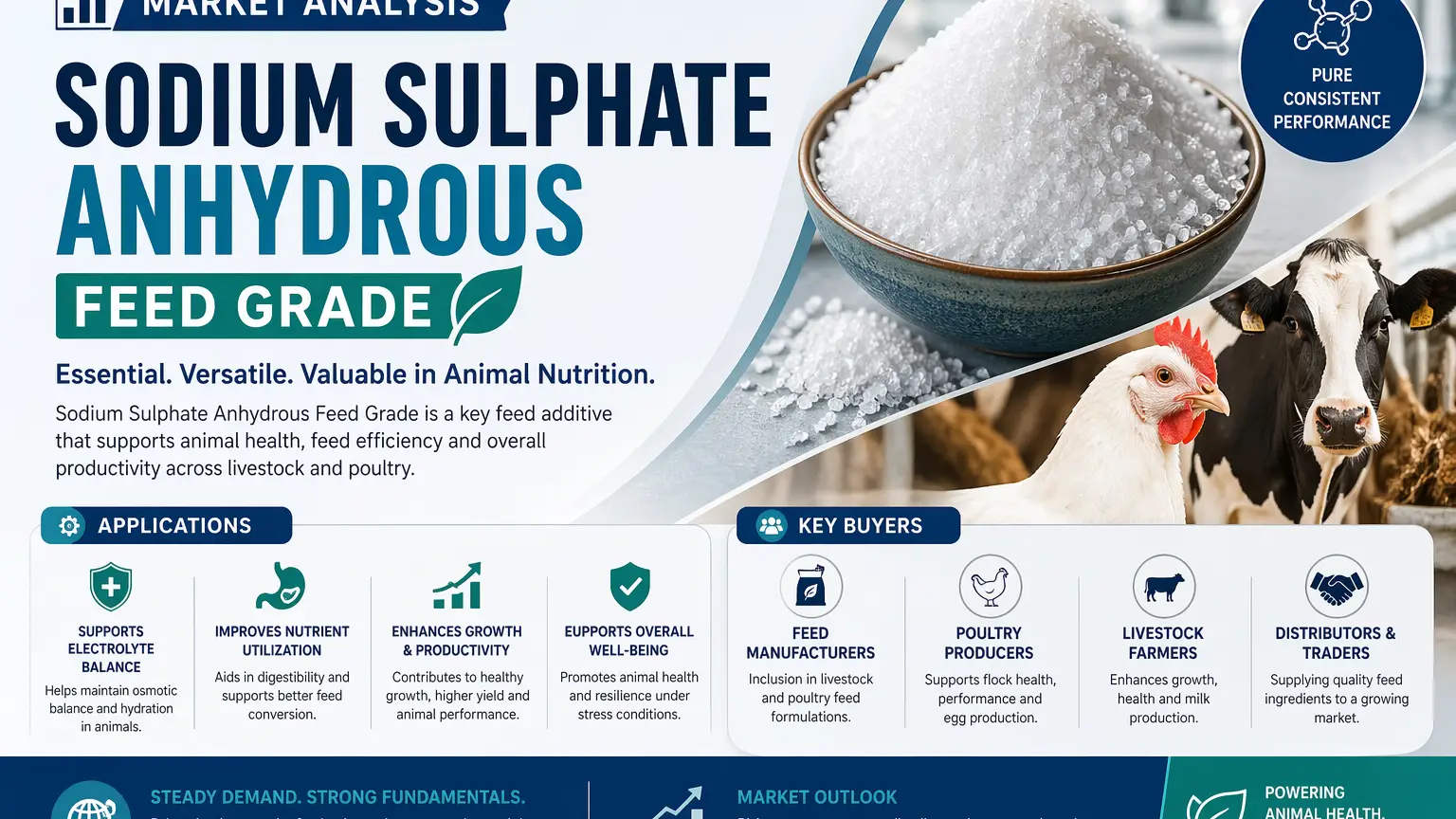
In feed-related applications, sodium sulphate anhydrous is used as a mineral balance agent and processing aid, particularly in compound feed manufacturing. Industrially, its strongest consumption base remains detergent fillers and glass production, where it enhances melting efficiency. The chemical’s adaptability as a platform material ensures sustained demand across both agricultural and manufacturing ecosystems.
Global Demand Dynamics and Buyer Segmentation
Demand is heavily concentrated among detergent manufacturers, glass producers, and feed compounders, with Asia-Pacific accounting for nearly 45% of global consumption. Buyers are increasingly large-scale industrial processors seeking stable bulk contracts. Emerging markets in the Middle East and Latin America are also expanding procurement as feed and chemical industries diversify.
Price Trends, Trade Flows and Margin Pressure
The sodium sulphate market in 2026 shows moderate price volatility, with FOB export values fluctuating between USD 120–180/MT depending on purity and freight conditions. Logistics disruptions and energy costs remain key margin pressure points, while long-term contracts help stabilize buyer-supplier relationships across major trade corridors.
Production Capacity and Supply Chain Outlook
Global production is dominated by integrated chemical manufacturers with access to by-product streams from hydrochloric acid and rayon production. Capacity expansion in China and Europe continues to influence global supply balance, with efficiency improvements reducing marginal production costs. However, feed-grade purification requirements are tightening quality standards across export markets.
Conclusion
As sodium sulphate anhydrous feed grade continues to evolve as a strategic platform chemical, its role in cost-efficient industrial processing becomes increasingly important. Market participants are prioritizing supply reliability, consistent quality, and global logistics integration to maintain competitiveness in 2026. In this landscape, Tradeasia International stands out as a global solution provider, offering integrated sourcing, dependable supply chains, and tailored chemical distribution services that support long-term industrial growth and market stability.
Sources
-
https://www.grandviewresearch.com/industry-analysis/sodium-sulfate-market-report
-
https://www.fortunebusinessinsights.com/sodium-sulfate-market-104901
-
https://www.icis.com/explore/commodities/chemicals/sodium-sulphate/
Leave a Comment