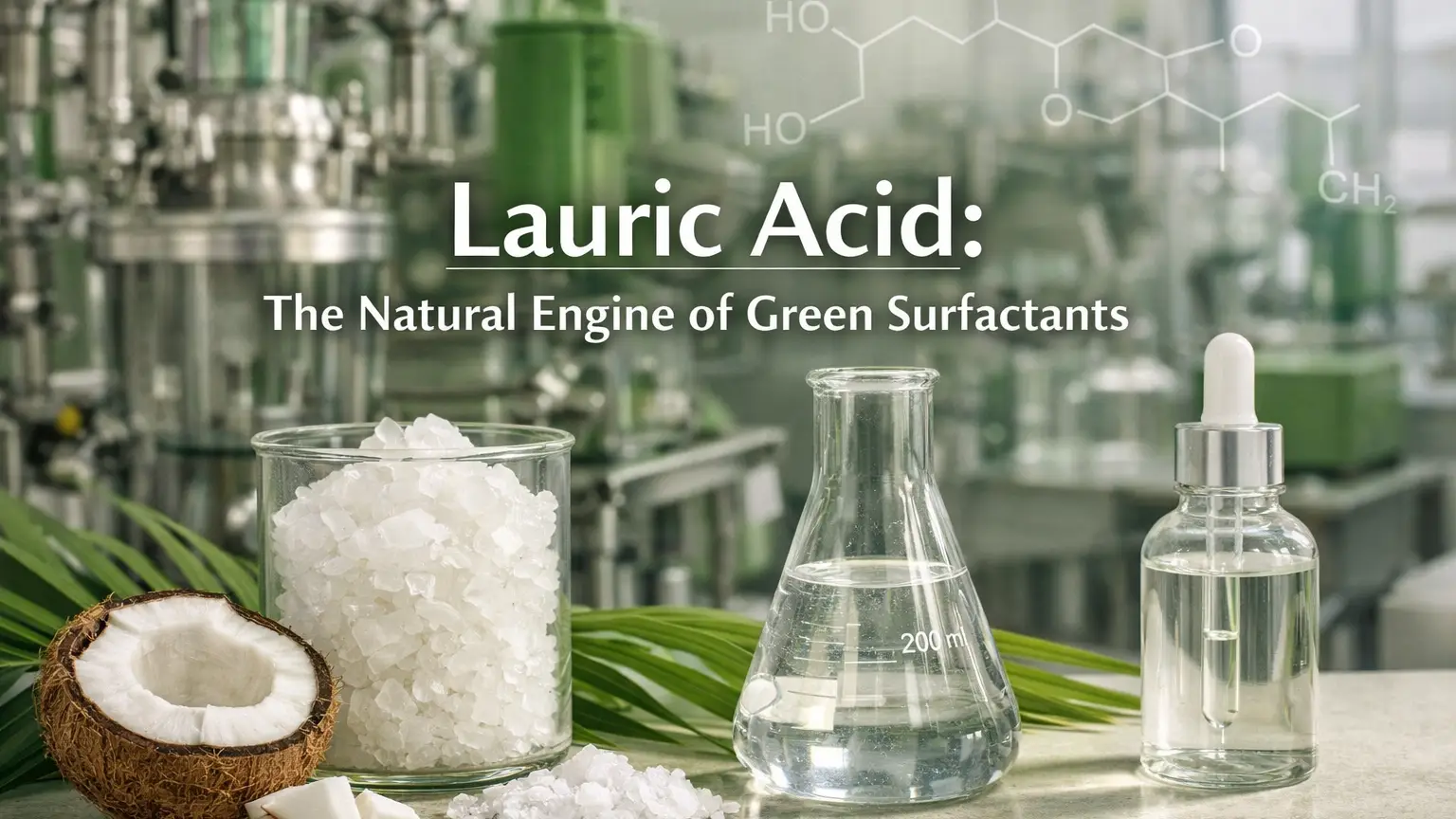
Lauric acid plays an important role in the development of green surfactants as industries move toward renewable and lower-impact raw materials. Derived mainly from palm kernel oil and coconut oil, lauric acid offers a bio-based alternative to petrochemical surfactant precursors while maintaining strong cleansing and foaming performance. Its balanced molecular structure supports biodegradability, mildness, and industrial scalability, making it relevant for personal care, home care, and industrial cleaning applications.
As regulations and sustainability standards continue to shape formulation strategies, lauric acid has become a commonly specified ingredient for surfactant systems designed to meet environmental and performance requirements.
Green Surfactants and Market Demand
The global surfactant industry is undergoing gradual change driven by regulatory frameworks such as REACH in the European Union and broader ESG expectations. These pressures have encouraged manufacturers to reduce reliance on fossil-based ingredients and increase the share of renewable materials in formulations.
Green surfactants, defined as surfactants derived from renewable feedstocks with favorable biodegradability profiles, now account for a growing portion of the market. Demand is supported by personal care, home care, and institutional cleaning segments where biodegradability, skin mildness, and supply transparency are increasingly relevant. Lauric acid fits well within this transition because it combines renewable sourcing with established processing routes.
Chemical Properties and Sources of Lauric Acid
Lauric acid, also known as dodecanoic acid, is a saturated fatty acid with a 12-carbon linear chain. This structure gives it a favorable balance between hydrophobic and hydrophilic behavior when converted into surfactants. Its melting point is approximately 43 to 44°C, and it has low water solubility, which supports stable surfactant structures and controlled release during use.
The primary commercial sources of lauric acid are palm kernel oil and coconut oil. Palm kernel oil typically contains 45 to 55 percent lauric acid, while coconut oil contains around 45 to 52 percent. Palm-based lauric acid dominates global supply due to higher agricultural yields and established oleochemical infrastructure in Southeast Asia.
Why Lauric Acid Is Suitable for Green Surfactant Formulation
Lauric acid is well suited for green surfactant development because its carbon chain length provides efficient surface activity without excessive persistence in the environment. Surfactants derived from C12 fatty acids often achieve effective foaming and cleansing at lower use levels compared to longer-chain alternatives.
From a formulation perspective, lauric acid derivatives perform well in both anionic and nonionic systems. They maintain foaming performance in hard water and show good compatibility with other bio-based surfactants. Industrially, lauric acid benefits from mature fractionation and purification processes, allowing consistent quality at scale.
Lauric Acid as a Renewable Feedstock in Surfactant Chemistry
In surfactant synthesis, lauric acid serves as a starting material for a range of chemical transformations. It can be converted into fatty alcohols, esters, amides, and salts through established oleochemical pathways. These reactions support the production of surfactants that reduce dependence on petroleum-derived intermediates.
Lauric acid is commonly transformed into lauryl alcohol through hydrogenation of methyl esters. Lauryl alcohol then serves as a precursor for alcohol ethoxylates and sulfates. Other pathways include esterification with sugars or amino acids, producing surfactants with improved biodegradability and mildness.
Key Lauric Acid–Based Surfactants and Derivatives
Several widely used surfactants are derived from lauric acid. Sodium lauryl sulfate is an anionic surfactant valued for its strong cleansing and foaming properties. Lauryl glucoside is a nonionic surfactant made by reacting lauryl alcohol with glucose, offering good biodegradability and skin compatibility.
Cocamidopropyl betaine, produced from lauric acid derivatives, functions as an amphoteric surfactant that enhances foam and reduces irritation in formulations. Sodium lauroyl sarcosinate is another lauric acid–based surfactant known for mild cleansing, often used in facial and oral care products.
These derivatives demonstrate how lauric acid supports a broad range of surfactant types with varying performance profiles.
Performance Characteristics of Lauric Acid–Based Surfactants
Surfactants derived from lauric acid are known for producing dense, stable foam. The C12 chain length allows efficient packing at the air-water interface, which supports foam formation even at lower active concentrations.
In personal care applications, lauric acid–based surfactants often show lower irritation potential compared to some petrochemical alternatives. In home care formulations, they provide effective removal of oily soils and maintain viscosity in the presence of electrolytes. These performance traits contribute to their continued use in both mass-market and premium products.
Applications in Personal Care and Home Care
In personal care products such as shampoos, body washes, and facial cleansers, lauric acid derivatives are used to balance cleansing power and mildness. Glucosides and sarcosinates derived from lauric acid are common in formulations designed for sensitive skin or sulfate-free claims.
In home care, lauryl sulfates and related surfactants are used in dishwashing liquids, laundry detergents, and surface cleaners. Esterquats derived from lauric acid are applied in fabric softeners to provide antistatic and softening effects. These applications reflect the versatility of lauric acid in both rinse-off and leave-on systems.
Environmental Benefits and Biodegradability
Lauric acid–based surfactants generally show high levels of biodegradability under standard testing methods such as OECD 301. Their linear structure allows microorganisms to break them down more readily than branched petrochemical surfactants.
Aquatic toxicity levels are typically moderate to low, depending on formulation and concentration. Life cycle assessments indicate that surfactants derived from palm-based lauric acid can offer lower carbon footprints than fossil-based equivalents, particularly when sourced from certified and traceable supply chains.
Lauric Acid in Sulfate-Free and Mild Systems
The growth of sulfate-free formulations has increased interest in lauric acid derivatives that do not rely on sulfation. Lauroyl isethionate, lauroyl lactylate, and lauryl glucoside are examples used in mild cleansing systems.
These surfactants support dense foam and good cleansing while reducing skin irritation. They also simplify processing by eliminating certain high-energy reaction steps, which contributes to incremental reductions in manufacturing impact.
Challenges and Practical Limitations
Despite its advantages, lauric acid faces practical challenges. Prices can fluctuate in line with palm oil markets and weather-related supply variations. These fluctuations affect cost planning for surfactant producers.
Formulation limitations also exist. Lauric acid derivatives may crystallize at lower temperatures, requiring careful formulation and storage considerations. Their effective pH range can be narrower than some synthetic surfactants, which may limit use in highly alkaline or acidic products.
Responsible Sourcing and Certification
Sustainability concerns around palm-based materials have led to increased use of certification schemes. RSPO and ISCC certifications help verify responsible sourcing and reduce risks related to deforestation and land-use change.
Traceability systems and third-party audits support procurement decisions, particularly for companies reporting Scope 3 emissions. Certified lauric acid allows formulators to align product performance with sustainability reporting requirements.
Future Outlook for Lauric Acid in Green Surfactants
Demand for lauric acid in green surfactant applications is expected to continue growing through the next decade. Regulatory developments and consumer preferences are likely to support higher adoption of bio-based surfactants.
Ongoing research into enzymatic processing and improved fractionation methods may reduce costs and improve consistency. Fermentation-derived fatty acids and hybrid oleochemical pathways are also under development, particularly in Asia-Pacific production hubs.
Conclusion
Lauric acid remains a practical and widely used feedstock in green surfactant development. Its renewable origin, established supply chain, and balanced performance characteristics support its role in both current and emerging formulations. While challenges related to sourcing and formulation remain, incremental improvements in processing and certification continue to strengthen its position.
For manufacturers sourcing lauric acid for surfactant applications, Chemtradeasia provides access to palm-based lauric acid supported by technical specifications and sustainability documentation, enabling consistent integration into green surfactant value chains.
Leave a Comment