Introduction: The Stakes of Allergen Management
In the food industry, a biological hazard (like Salmonella) can be cooked out. A physical hazard (like metal) can be detected by magnets. But a chemical hazard—specifically a Food Allergen—cannot be destroyed by heat, processing, or freezing. Once an allergen enters a product where it does not belong, that product is permanently compromised.
For food manufacturers, allergen control is not just a safety requirement; it is the single largest cause of food recalls globally. A simple dusting of wheat flour on a pallet of gluten-free cornstarch, or a misprinted label on a milk-containing snack, can trigger a recall costing millions of dollars and causing potentially fatal anaphylaxis for consumers.
This guide outlines the technical protocols for an Allergen Control Plan (ACP), focusing on the critical non-processing stages: Logistics, Warehousing, and Labeling.
Phase 1: Distribution and Receiving (The First Line of Defense)
Allergen management begins before the truck even backs into the loading dock. If an allergen is not identified the moment it enters the facility, it becomes a "ghost" ingredient that can contaminate the entire supply chain.
The Vehicle Inspection
The distribution process relies on mixed-load transport (LTL). A truck delivering your non-allergen Rice Flour might have previously hauled Peanuts.
-
Protocol: Receiving staff must inspect the vehicle condition before unloading. Look for structural damage, strange odors, or visible powders on the floorboards. If there is spilled residue from a previous load, the shipment should be rejected to prevent tracking that residue into the warehouse.
The Integrity Check
-
Damaged Packaging: Any bag with a tear, puncture, or water stain is a high-risk vector. A torn bag of Milk Powder can release dust that settles on adjacent pallets of Soy Protein.
-
Protocol: "Reject or Isolate." Damaged allergen containers should never enter the general storage area. They must be immediately sealed in plastic and either rejected or moved to a quarantine zone.
Tagging and Identification
You cannot manage what you cannot see. Standard white labels are insufficient for allergens.
-
Color-Coding System: Most modern facilities use a visual system (e.g., Yellow tags for Wheat, Red for Peanuts, Blue for Milk). These distinct, large labels should be applied to every pallet and individual bag upon receipt.
-
The "Master List": The receiving team must verify the ingredient against the facility’s Master Allergen List. If a supplier substitutes a spice blend and the new version contains "Mustard" (an allergen) where the old one did not, the receiving team is the only barrier stopping that allergen from entering production unflagged.
Phase 2: Storage Strategy (The Top-Down Rule)
Once inside the warehouse, gravity and airflow become the enemies. Allergen dust is light and mobile. Storage protocols are designed to fight gravity.
The "Top-Down" Segregation Rule
This is the golden rule of warehouse safety: Never store an allergen above a non-allergen.
-
Scenario: If a bag of Wheat Flour is stored on the top rack and a bag of Rice Flour is on the bottom rack, a forklift accident or a small tear could cause wheat dust to rain down onto the rice flour. The rice flour is now contaminated, but visually appears clean.
-
The Hierarchy:
-
Top Racks: Clean / Non-Allergen ingredients.
-
Middle Racks: Unique allergens (segregated by type).
-
Bottom Racks: The "High Risk" allergens (e.g., Peanuts or the facility's most common allergen).
Vertical vs. Horizontal Segregation
-
Best Practice (The Allergen Cage): Ideally, allergens should be stored in a completely separate room or a fenced-off "cage" with dedicated ventilation to prevent airborne cross-contact.
-
Acceptable Practice (Horizontal Separation): If a separate room isn't possible, use significant horizontal distance. Do not place Milk Powder and Soy Powder side-by-side. Leave a "buffer pallet" of a non-allergen (like Salt or Sugar) between them to act as a barrier.
Dedicated Tools
Cross-contact often happens via equipment. A forklift that drives through a spill of peanut flour and then drives into the gluten-free zone tracks the allergen on its tires.
-
Spill Kits: Dedicated allergen spill kits must be available. Spills must be cleaned immediately, not "at the end of the shift."
-
Dedicated Scoops: In weighing rooms (dispensing), scoops and bins must be color-coded. A scoop used for Egg Powder must never touch a bin of Sugar.
Phase 3: Labeling and Final Dispatch (The Communication)
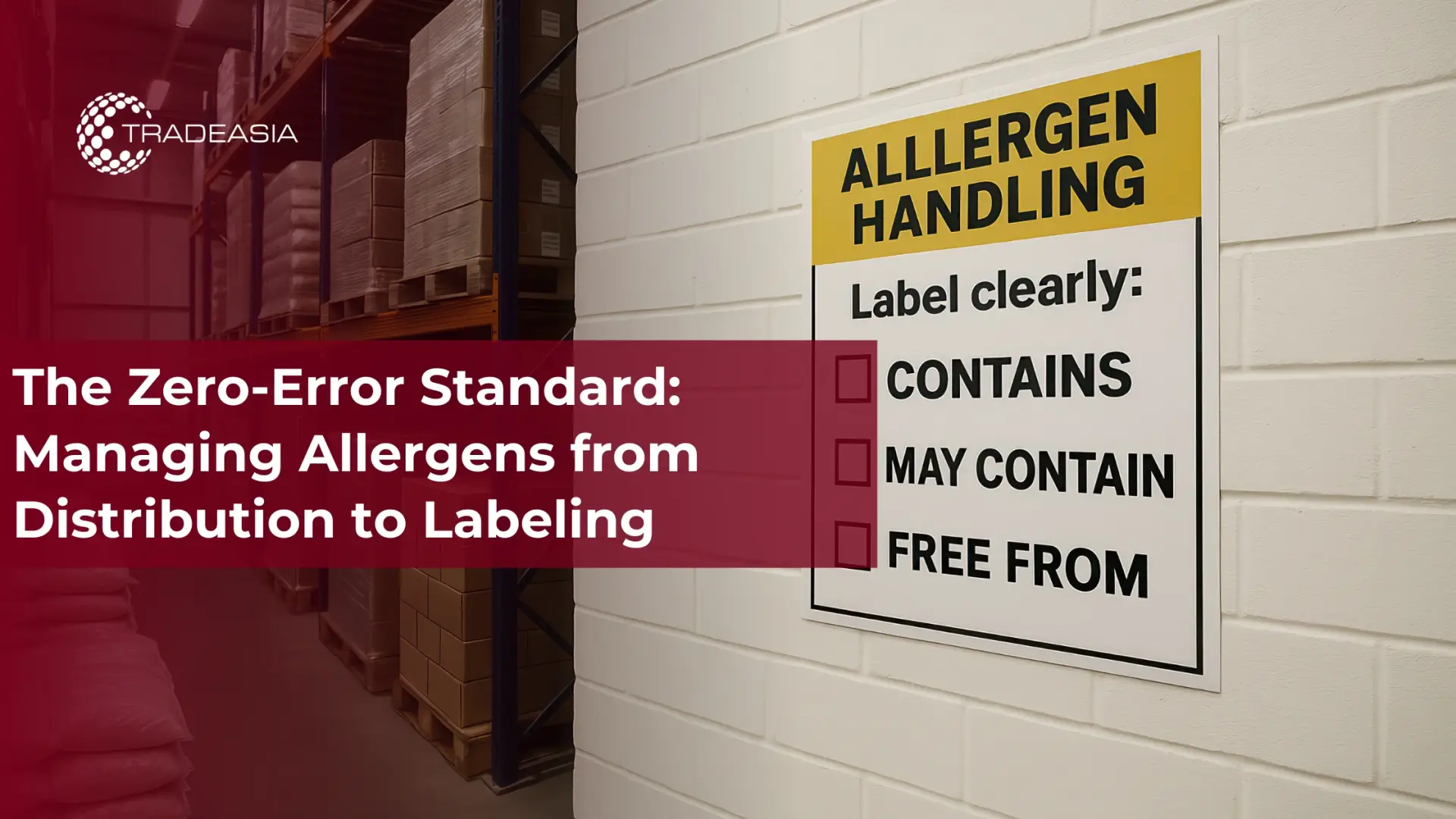
The Labeling stage is where the vast majority of recalls happen. The product inside the bag might be perfect, but if the label is wrong, the product is lethal. This is the final communication link to the consumer.
The "Big 8" (or 9) and Global Standards
You must label according to the destination country, not just the manufacturing country.
-
USA (FDA): Milk, Eggs, Fish, Crustacean Shellfish, Tree Nuts, Peanuts, Wheat, Soy, and Sesame (the newest addition).
-
EU: Includes the above plus Celery, Mustard, Sulphites, Lupin, and Molluscs.
-
Southeast Asia: Regulations vary, but exporting requires adherence to the strictest standard of the target market.
Bold and "Contains" Statements
-
Ingredient List: Allergens must be declared within the ingredient list using their common name (e.g., "Whey (Milk)", "Caseinate (Milk)", "Lecithin (Soy)").
-
Summary Statement: A "Contains: Milk, Soy" statement should be placed immediately adjacent to the ingredient list. The font size and boldness must meet regulatory minimums.
The "May Contain" (Precautionary Allergen Labeling - PAL)
This statement (e.g., "Produced in a facility that also processes Peanuts") is often misunderstood.
-
Not a Substitute for GMP: You cannot use a "May Contain" label to excuse poor cleaning practices. This label should only be used after a Risk Assessment determines that cross-contact is unavoidable despite best practices (e.g., shared lines where dry cleaning cannot remove 100% of microscopic dust).
Line Clearance and Label Verification
The most dangerous moment in packaging is the "Changeover."
-
The Scenario: The line was running "Spicy Chips (Contains Soy)." The next run is "Salted Chips (No Allergens)." If the operator forgets to remove the remaining roll of "Spicy" labels from the machine, the "Salted" chips will be packed with "Spicy" labels.
-
Protocol: A strict Line Clearance procedure is required. All previous labels, film, and boxes must be physically removed from the area before the new packaging is brought out. Electronic scanners (barcode verifiers) should be used to ensure the label matches the production code.
The Concept of "Cross-Contact" vs. "Cross-Contamination"
Industry professionals should use precise terminology.
-
Cross-Contamination usually refers to bacteria (like E. coli moving from raw meat to salad). Cooking usually fixes this.
-
Cross-Contact refers to allergens (like cheese residue touching a vegan burger). Cooking does not fix this. Understanding this distinction emphasizes why cleaning and segregation are the only solutions—you cannot "kill" an allergen.
Conclusion
Allergen management is a chain that is only as strong as its weakest link. A pristine production process is useless if the raw material was contaminated on the receiving dock or if the final box was mislabeled in the warehouse.
By implementing strict Vehicle Inspections, adhering to the Top-Down Storage Rule, and enforcing rigid Label Verification protocols, manufacturers can protect their consumers and their brand reputation from the catastrophic risks of undeclared allergens.
Partner with Food Additives Asia for Safety Solutions
Managing a safe supply chain requires trusted ingredients. At Food Additives Asia, we understand the critical nature of allergen documentation. We provide:
-
Full Documentation: Comprehensive COAs and Allergen Statements for every ingredient.
-
Allergen-Free Options: Alternatives like Sunflower Lecithin (Soy-Free) and Pea Protein (Dairy-Free).
-
Secure Logistics: rigorous handling protocols to ensure ingredient integrity from our warehouse to your door.
Secure your supply chain today. Contact us for allergen-specific documentation and ingredient solutions at foodadditivesasia.com.
Leave a Comment