Introduction
Paper gloss is a defining attribute for many premium print and packaging applications. It influences how light reflects from the paper surface, shaping visual clarity, color intensity, and overall product appeal. For printing and writing papers, magazines, catalogs, and high-end packaging, consistent gloss and smooth surface finish are often as important as brightness and opacity.
As paper machines and coating lines continue to operate at higher speeds, surface engineering has become central to product differentiation. Mineral pigments play a key role in this process by filling surface irregularities and supporting uniform coating formation. Among these pigments, kaolin clay stands out for its ability to enhance paper gloss while maintaining printability, runnability, and cost efficiency. Its performance is closely linked to particle shape, size control, and interaction with coating binders, making kaolin an essential material for modern paper manufacturing.
What Is Kaolin and Why It Matters in Paper Production
Kaolin clay, sometimes referred to as china clay, is a naturally occurring hydrous aluminum silicate with the chemical formula Al₂Si₂O₅(OH)₄. In paper manufacturing, kaolin is widely used both as a filler and as a coating pigment due to its fine particle size, chemical stability, and characteristic platy structure.
Filler-grade kaolin contains slightly coarser particles that extend fiber usage, improve opacity, and support sheet formation. Coating-grade kaolin undergoes further processing to achieve tighter particle size distributions and higher purity. These refined grades are designed specifically to enhance surface smoothness, gloss development, and print performance.
Kaolin’s inert chemistry allows it to perform reliably across a wide pH range and in combination with common coating binders such as starch, latex, and synthetic polymers. This versatility makes kaolin a preferred choice for manufacturers seeking consistent surface quality across different paper grades.
How Kaolin Enhances Paper Gloss
Particle Morphology and Surface Leveling
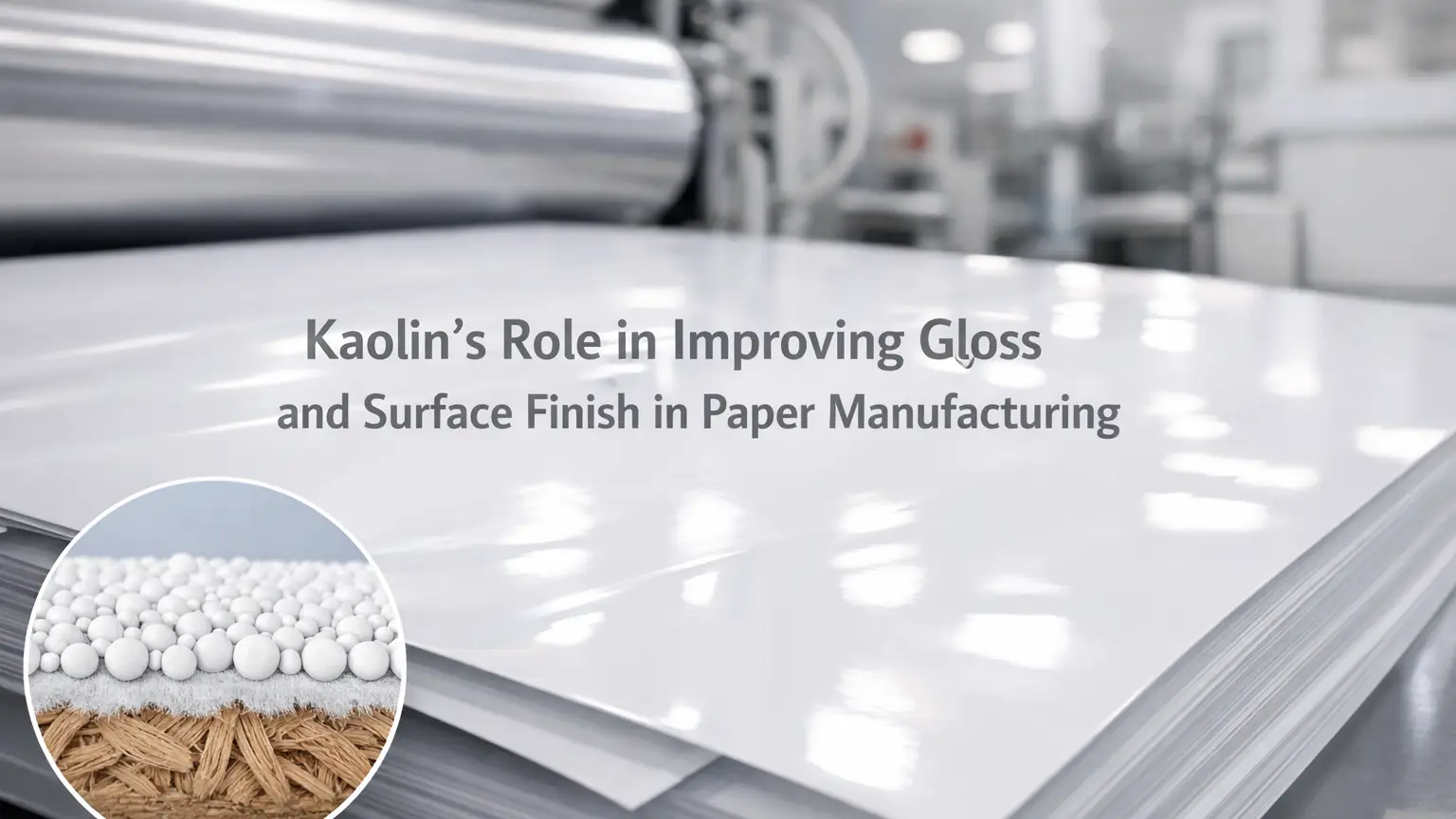
The gloss-enhancing effect of kaolin begins with its platelet-shaped particles. These flat, thin platelets naturally orient parallel to the paper surface during coating application, drying, and calendering. This orientation allows kaolin to fill micro-scale surface irregularities and reduce roughness.
As the surface becomes more uniform, light reflects more evenly rather than scattering in multiple directions. This increase in specular reflection produces higher gloss levels and a smoother visual appearance. Compared to pigments with more rounded shapes, kaolin provides superior surface leveling, which directly translates into improved gloss.
Interaction with Coating Binders
Kaolin works in close coordination with binders in paper coatings. Its surface chemistry allows strong adhesion with starches and latex systems, forming a dense and cohesive coating layer. This structure limits excessive porosity at the surface while maintaining enough internal voids for ink interaction.
The result is a smooth, compact coating that supports both gloss and printability. Ink remains closer to the surface, enhancing color density and sharpness without compromising drying speed or adhesion.
Kaolin in Paper Coatings and Industrial Processing
Kaolin is a cornerstone pigment in coated paper formulations. In coating applications, kaolin often represents a significant portion of the pigment system due to its balance of performance and cost.
Modern coating operations rely on high-solids slurries, often reaching 65 to 70 percent solids content. Well-processed kaolin exhibits stable rheology under these conditions, enabling uniform application through blade, rod, or roll coating methods at line speeds exceeding 1,000 meters per minute.
During calendering, kaolin further contributes to gloss development. The pressure and heat applied in calendering enhance platelet alignment and surface densification, resulting in a smoother, glossier finish. This response to calendering makes kaolin especially valuable for producing high-gloss coated papers with consistent surface quality.
Impact on Different Paper Grades and End Uses
Kaolin’s contribution to gloss and surface finish varies across paper grades, though its influence remains consistently positive.
In printing and writing papers, kaolin improves smoothness and ink holdout, leading to cleaner images and reduced linting during printing. Magazine and catalog papers benefit from enhanced color vibrancy and uniform gloss, which are critical for visual impact and brand perception.
Packaging and specialty papers also gain from kaolin’s surface-enhancing properties. Higher gloss and improved opacity support premium branding and decorative finishes, while maintaining structural integrity and runnability during converting processes.
Quality Parameters That Influence Gloss Performance
Kaolin’s effectiveness in enhancing gloss depends on strict control of several quality parameters. Particle size distribution is critical, with coating grades often requiring 90 to 96 percent of particles below 2 microns. Excessively fine particles can reduce opacity, while coarse fractions may compromise smoothness and surface uniformity.
Brightness levels above 89 GE or ISO support clean, neutral color reproduction. Low levels of iron and titanium oxides help prevent discoloration and maintain consistency across production batches. Platelet shape factor also plays a role, as higher aspect ratios promote better alignment and surface leveling.
Dispersibility and rheological stability are equally important. Consistent slurry behavior at high solids ensures uniform coating application and predictable gloss development. Reliable suppliers maintain tight process control to deliver kaolin with consistent morphology and performance.
Strategic Sourcing for Consistent Gloss Quality
Achieving reliable gloss performance requires more than selecting the right formulation. Consistent supply of high-quality kaolin is essential for stable paper production. Variations in particle size, brightness, or impurity levels can lead to visible differences in surface finish and print quality.
Experienced global supplier and distributor such as Chemtradeasia support paper manufacturers by providing access to well-characterized kaolin grades, supported by technical documentation and quality assurance. This level of support helps mills optimize coating formulations, reduce variability, and maintain competitive positioning in premium paper markets.
Conclusion
Kaolin plays a vital role in improving paper gloss and surface finish through its unique platelet morphology, stable chemistry, and strong interaction with coating binders. By leveling the paper surface and promoting uniform light reflection, kaolin enhances visual quality across a wide range of paper grades.
For manufacturers targeting high-end print and packaging applications, selecting the appropriate coating-grade kaolin is a strategic decision that affects both product quality and process efficiency. With reliable sourcing and precise quality control, kaolin remains one of the most effective paper coating pigments for delivering smoothness, gloss, and lasting market.
Leave a Comment