Introduction
Japonica rice occupies a foundational role in Asian food systems, not merely as a staple carbohydrate but as a functional ingredient that defines texture, mouthfeel, and eating experience across a wide spectrum of traditional and modern foods. Distinguished by its short-to-medium grain length, high amylopectin content, and naturally sticky texture when cooked, Japonica rice has become deeply embedded in East Asian and parts of Southeast Asian culinary traditions. Beyond cultural preference, its physicochemical properties make it uniquely suited for applications where cohesiveness, softness, and structural integrity are critical.
As Asian food systems continue to modernize and industrialize—while still preserving sensory authenticity—Japonica rice increasingly functions as a bridge between traditional cuisine and scalable food manufacturing. Its role extends from household cooking to processed foods, frozen meals, fermented products, and even functional food formulations, reinforcing its strategic importance within the regional food ingredient landscape.
Structural Characteristics of Japonica Rice
The defining functional attributes of Japonica rice originate from its starch composition. Compared to Indica varieties, Japonica rice contains a significantly higher proportion of amylopectin relative to amylose. This starch structure is responsible for the rice’s characteristic soft, moist, and cohesive texture after cooking. Upon gelatinization, Japonica rice granules swell uniformly, forming a smooth, elastic matrix that binds grains together without excessive hardness or dryness.
This structural behavior delivers consistent texture even under varying cooking methods, making Japonica rice highly forgiving in both domestic and industrial preparation. Its ability to retain moisture and resist retrogradation also contributes to extended palatability, particularly important in foods that are held warm, refrigerated, or reheated. These intrinsic properties explain why Japonica rice is often favored in applications where texture stability is more critical than grain separation.
Functional Performance in Texture-Driven Food Applications
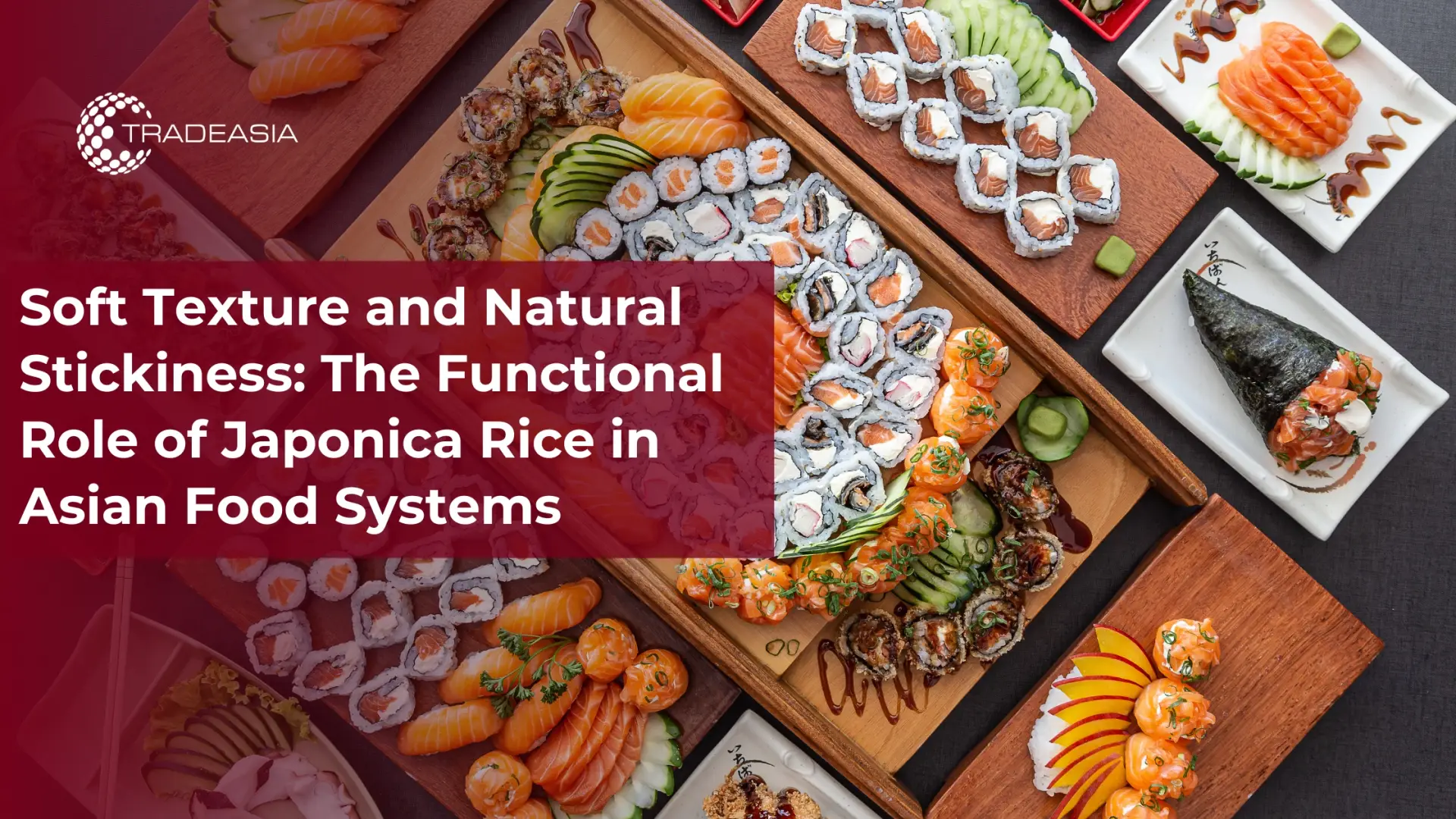
In texture-sensitive foods, Japonica rice functions as a natural binding and structuring agent. Its inherent stickiness allows it to form compact shapes without the need for additional binders or emulsifiers, a characteristic that is essential in foods such as sushi, rice balls, dumpling fillings, and molded rice products. The softness of cooked Japonica rice also enhances oral processing, delivering a gentle bite and smooth breakdown that aligns with consumer expectations in many Asian cuisines.
In processed foods, Japonica rice contributes to uniform texture across production batches. Its predictable gelatinization behavior enables manufacturers to control viscosity, cohesion, and moisture distribution, particularly in rice-based snacks, porridge products, and ready-to-eat meals. These functional advantages reduce formulation complexity and improve product consistency, reinforcing Japonica rice’s value beyond its role as a staple grain.
Cultural and Culinary Integration Across Asian Cuisines
Japonica rice is deeply intertwined with culinary identity in East Asia, particularly in Japan, South Korea, and parts of China, where texture is as important as flavor. In Japanese cuisine, Japonica rice is essential for sushi, onigiri, and donburi, where grain adhesion and shape retention directly influence product quality. Korean cuisine relies on its soft stickiness for dishes such as bap, gimbap, and rice cakes, where cohesion supports both eating experience and presentation.
In China, Japonica rice is widely consumed in northeastern regions and urban centers, often preferred for steamed rice, congee, and processed rice products. Its adoption has also expanded into Southeast Asia, particularly in premium Japanese and Korean food segments in countries such as Indonesia, Thailand, and Vietnam. In these markets, Japonica rice increasingly symbolizes quality, authenticity, and refined texture, influencing consumer purchasing behavior beyond traditional staple consumption.
Industrial Food Applications and Processing Advantages
From an industrial perspective, Japonica rice offers several processing advantages that support its integration into modern food systems. Its stable starch behavior allows for efficient cooking, shaping, freezing, and reheating without significant texture degradation. This makes it particularly suitable for frozen meals, chilled bento products, microwaveable rice bowls, and institutional catering foods.
Japonica rice is also widely used in rice-based flours and pastes for confectionery, bakery hybrids, and gluten-free formulations. In mochi, rice cakes, and dessert applications across Japan, Korea, and China, its natural elasticity and cohesiveness eliminate the need for synthetic texturizers. As food manufacturers respond to consumer demand for simpler formulations and recognizable ingredients, Japonica rice’s multifunctionality strengthens its appeal as both a primary ingredient and a functional base material.
Nutritional Profile and Consumer Perception
Nutritionally, Japonica rice is primarily valued for its digestibility and energy provision. Its soft texture and starch composition make it suitable for a wide demographic range, including children and the elderly, particularly in porridge and soft-food applications. While it is not positioned as a high-fiber or high-protein grain, its role in balanced meals remains central within Asian dietary patterns.
From a consumer perception standpoint, Japonica rice is often associated with premium quality, cleanliness, and culinary authenticity. In export markets, it is frequently marketed alongside Japanese or Korean food culture, enhancing perceived value. This positive perception supports its continued use in both traditional foods and modern packaged products, even as dietary diversification increases across Asia.
Market of Japonica Rice
The market for Japonica rice remains resilient, supported by stable demand in core producing and consuming regions such as Japan, China, and South Korea, alongside expanding niche demand in Southeast Asia. Growth is less driven by volume expansion and more by value differentiation, particularly in premium foodservice, ready-to-eat meals, and culturally authentic packaged foods. As Asian cuisines gain greater global exposure, Japonica rice is likely to maintain its position as a texture-defining grain rather than a commodity staple.
Conclusion
Japonica rice continues to function as a cornerstone of Asian food systems, offering a unique combination of soft texture, natural stickiness, and processing reliability. Its starch structure supports a wide range of culinary and industrial applications, from traditional rice dishes to modern frozen and ready-to-eat foods. As food manufacturers balance scalability with sensory authenticity, Japonica rice remains an essential ingredient that delivers both functional performance and cultural integrity.
For sourcing inquiries, technical specifications, or application support related to Japonica rice and other food ingredients, please contact food@chemtradeasia.com or visit www.foodadditivesasia.com to connect with Tradeasia International’s food ingredients team.
Leave a Comment