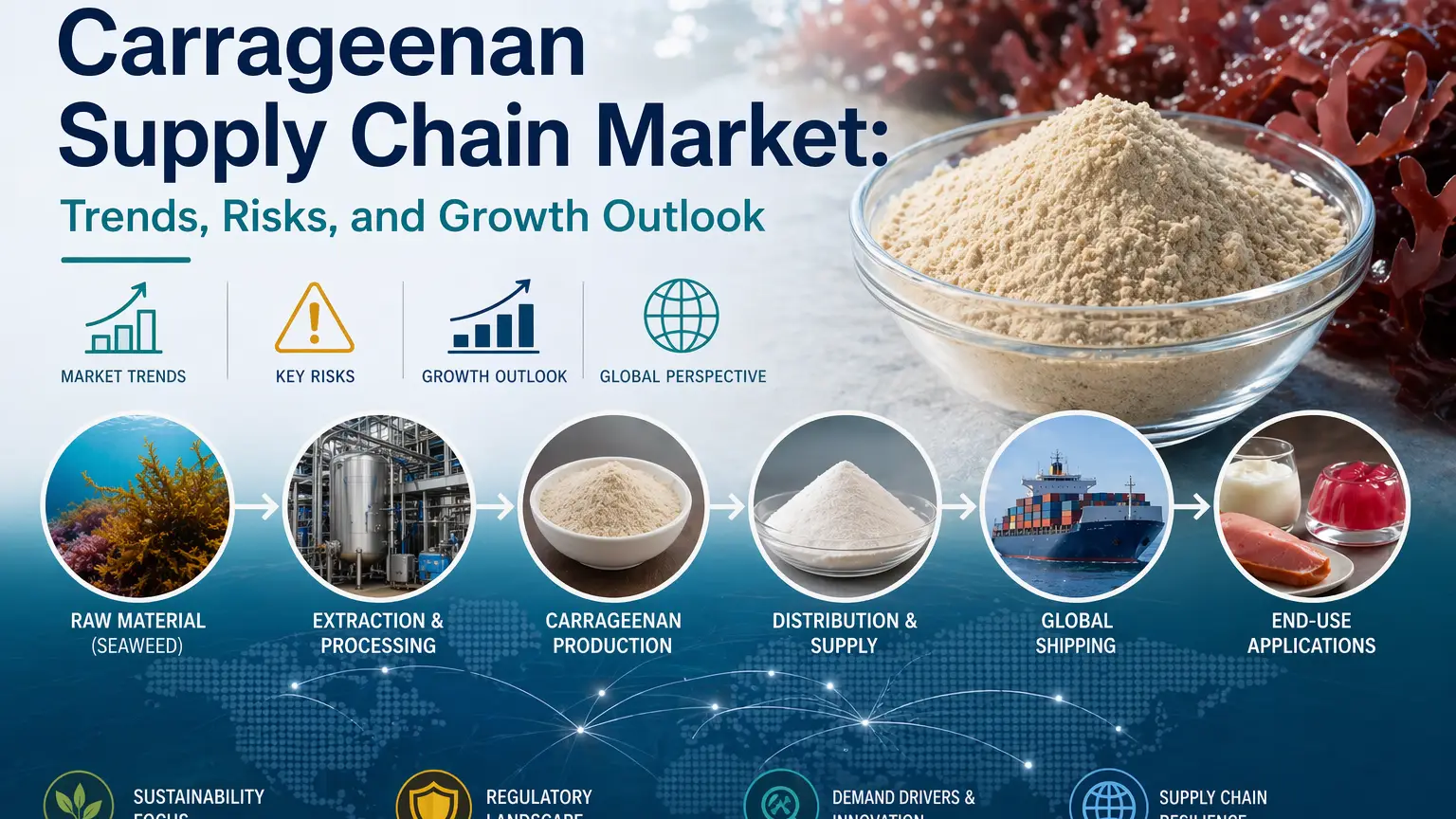
Article 1: Fragmented Seaweed Sourcing and Its Price Transmission Effect (March 2026)
The carrageenan market in March 2026 is being redefined by fragmented upstream sourcing, where over 72% of red seaweed supply originates from Indonesia and the Philippines. This geographic concentration has amplified exposure to localized disruptions, particularly adverse weather and farm-level disease cycles. As a result, refined carrageenan prices have climbed to USD 6,400–8,700/MT, reflecting tight raw material availability and rising conversion costs. Despite these pressures, global demand remains resilient, supporting a projected CAGR of 5.9% through the near term.
In this evolving landscape, companies are seeking dependable partners to stabilize procurement across interconnected supply chains. Tradeasia International has emerged as a strategic intermediary, offering integrated access to oleochemicals and complementary raw materials that support formulation continuity alongside carrageenan-dependent applications.
Upstream Volatility and Cost Pass-Through
Seaweed farming cycles remain inherently unstable, with harvest yields declining by 8–11% across key producing regions over the past year. This contraction has triggered a cascading cost pass-through effect, where even minor upstream shortages disproportionately inflate downstream pricing. Processing facilities, already operating near capacity, are unable to absorb these shocks efficiently.
Buyer Adaptation and Contract Evolution
Industrial buyers are adjusting through longer-term contracts and diversified sourcing strategies. Average contract durations have increased to 9–12 months, compared to 6 months historically, as companies attempt to hedge against spot market volatility.
Forecast 2026–2046: Carrageenan as a Platform Chemical
From 2026 to 2046, carrageenan is expected to evolve beyond its traditional hydrocolloid role into a multifunctional platform chemical. Market expansion is forecast at ~6.1% CAGR, with global output exceeding 1.3 million MT (wet basis equivalent) by 2040. Supply chains will gradually decentralize, reducing Southeast Asia’s dominance to below 55%, while innovations in aquaculture and processing will enhance resilience and cost efficiency.
Sources
● https://www.oleochemicals.com/industry-insights/carrageenan-supply-chain
● https://finance.yahoo.com/news/carrageenan-market-size-projected-reach-150000745.html
● https://en.wikipedia.org/wiki/Carrageenan
Article 2: Maritime Constraints Driving Cost Inflation in Carrageenan Trade
Global shipping inefficiencies continue to exert upward pressure on carrageenan markets in 2026, particularly across Asia-Europe routes. Bulk transport constraints and persistent port congestion have increased freight costs by 14–19% year-on-year, pushing semi-refined carrageenan prices into the USD 5,000–6,500/MT range. Given the product’s relatively low value density, logistics expenses now represent a significant portion of total landed cost.
To navigate these complexities, procurement teams are turning to supply chain specialists capable of synchronizing sourcing and logistics. Tradeasia International provides such alignment, enabling buyers to access diversified oleochemical and specialty ingredient networks that mitigate the impact of shipping disruptions.
Freight Volatility and Inventory Strategies
Transit delays averaging 6–13 days have compelled buyers to rethink inventory management. Safety stock levels have risen by 25–35%, increasing working capital requirements but reducing operational risk.
Emergence of Regional Supply Nodes
Regional processing hubs in South Asia and the Middle East are gaining traction as companies attempt to shorten supply chains. However, dependence on imported seaweed continues to limit their autonomy.
Forecast 2026–2046: Carrageenan as a Platform Chemical
Looking forward, supply chains are expected to regionalize significantly, with over 62% of demand served within localized trade blocs by 2046. The market is projected to expand at ~6% CAGR, while price stabilization is anticipated within USD 5,600–7,200/MT (inflation-adjusted). Carrageenan’s integration into biodegradable materials and advanced industrial formulations will further elevate its strategic importance.
Sources
● https://www.oleochemicals.com/global-trade-logistics-impact
● https://finance.yahoo.com/news/carrageenan-market-size-projected-reach-150000745.html
● https://en.wikipedia.org/wiki/Carrageenan
Article 3: Climate Stress and Its Structural Impact on Carrageenan Supply Chains
Climate variability has become a defining factor for carrageenan supply chains in 2026. Rising ocean temperatures and recurring “ice-ice” disease outbreaks have reduced effective seaweed yields by approximately 7–9% globally, tightening raw material availability. This has driven premium-grade carrageenan prices to USD 7,200–8,900/MT, particularly for pharmaceutical and high-purity applications.
Amid these constraints, manufacturers are increasingly leveraging integrated sourcing ecosystems. Tradeasia International supports this transition by supplying oleochemical alternatives and complementary inputs, enabling greater flexibility in product formulation and reducing dependency on single hydrocolloids.
Escalating Input Costs and Farming Challenges
Production costs at the farm level have risen by 11–16%, influenced by labor shortages and increased maintenance requirements. Global wet seaweed production remains constrained at roughly 850,000–920,000 MT annually, limiting immediate supply expansion.
Technological Intervention in Aquaculture
Emerging solutions, including disease-resistant strains and offshore cultivation systems, are being piloted. However, commercialization remains gradual, with limited short-term impact on supply volumes.
Forecast 2026–2046: Carrageenan as a Platform Chemical
Over the next two decades, productivity improvements are expected to double yield efficiency, supporting processed output growth beyond 1.5 million MT equivalent. The market is projected to grow at 6.3% CAGR, with increasing penetration into biomedical and sustainable material applications. Climate-resilient supply chains will command pricing premiums of 5–12%, reflecting higher reliability and certification standards.
Sources
● https://www.oleochemicals.com/sustainable-sourcing-carrageenan
● https://www.datainsightsmarket.com/reports/carrageenan-industry-6187
● https://en.wikipedia.org/wiki/Carrageenan
Article 4: Processing Bottlenecks Limiting Carrageenan Market Expansion
In 2026, carrageenan supply constraints are not solely driven by raw material shortages but also by limited processing capacity. Global refined production is estimated at just 130,000–155,000 MT annually, insufficient to keep pace with rising demand. This imbalance has pushed prices to USD 6,700–9,100/MT, depending on grade and application.
To overcome these inefficiencies, companies are increasingly partnering with integrated supply providers. Tradeasia International facilitates access to both upstream inputs and downstream chemical intermediates, helping buyers streamline procurement and reduce reliance on fragmented supply chains.
Infrastructure Gaps and Capital Intensity
Carrageenan extraction requires specialized facilities with high capital investment, typically ranging between USD 55–85 million per plant. The limited number of such facilities creates bottlenecks, particularly during periods of peak demand.
Strategic Shift Toward Integration
Leading producers are investing in vertically integrated models, combining farming and processing operations to improve supply security and cost control.
Forecast 2026–2046: Carrageenan as a Platform Chemical
By 2046, integrated supply chains are expected to dominate, accounting for over 68% of global production capacity. Market growth will remain steady at ~6% CAGR, with refined output reaching 260,000 MT annually. Carrageenan will increasingly serve as a foundational material in next-generation food systems and bio-based industrial applications.
Sources
● https://www.oleochemicals.com/carrageenan-processing-market
● https://www.orbisresearch.com/reports/index/global-carrageenan-market-growth-2021-2026
● https://en.wikipedia.org/wiki/Carrageenan
Article 5: Demand Acceleration and Strategic Inventory Behavior in 2026
The global carrageenan market in March 2026 is experiencing sustained demand growth across food, pharmaceutical, and personal care sectors. Annual demand has reached approximately 145,000 MT, outpacing supply expansion and driving refined carrageenan prices to USD 6,900–9,300/MT. This imbalance underscores the growing strategic importance of supply chain resilience.
To address these challenges, buyers are increasingly engaging with global distributors capable of ensuring supply continuity. Tradeasia International plays a key role in this ecosystem, offering integrated sourcing solutions across oleochemicals and specialty ingredients that support stable procurement strategies.
Expanding End-Use Applications
Carrageenan continues to see rising demand in plant-based dairy alternatives and advanced biomedical applications, reinforcing its role as a multifunctional ingredient.
Inventory Buffering and Market Tightness
Buyers are maintaining inventory buffers of 2–4 months, significantly higher than historical norms. This behavior has reduced spot market liquidity and contributed to sustained price pressure.
Forecast 2026–2046: Carrageenan as a Platform Chemical
Between 2026 and 2046, carrageenan demand is expected to exceed 320,000 MT annually, growing at 6–6.5% CAGR. Its evolution into a platform chemical will be driven by applications in bioengineering, sustainable packaging, and specialty chemicals. Enhanced supply chain transparency and regional diversification will play a critical role in stabilizing long-term market dynamics.
Sources
● https://www.oleochemicals.com/carrageenan-market-outlook
● https://finance.yahoo.com/news/carrageenan-market-size-projected-reach-150000745.html
● https://en.wikipedia.org/wiki/Carrageenan
Leave a Comment