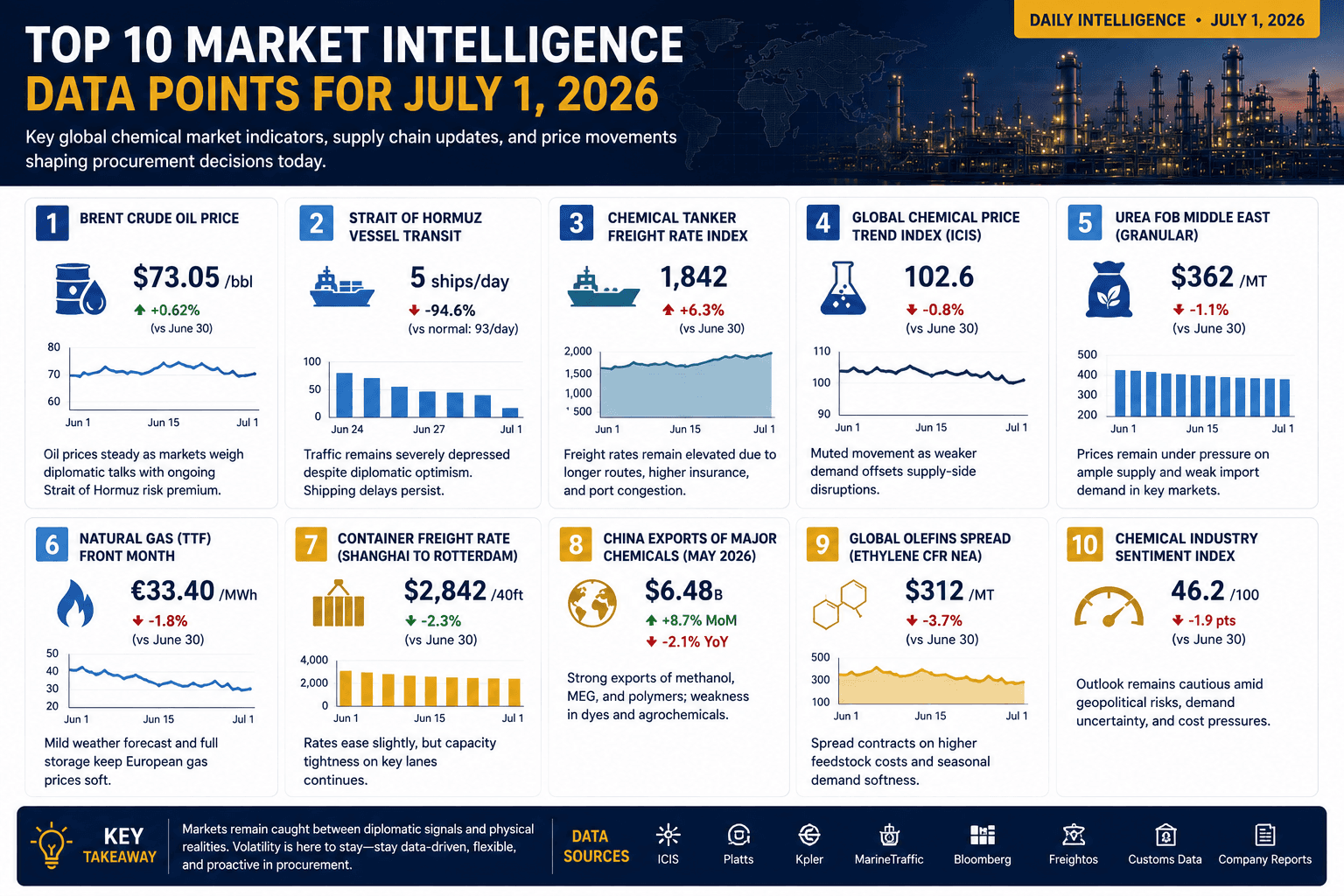
The global glacial acetic acid market entered 2026 facing a challenge that originated far upstream in the chemical value chain. A surge in methanol prices, driven by geopolitical tensions affecting Middle Eastern supply routes, has increased production costs for acetic acid producers worldwide.
Because acetic acid production depends heavily on methanol feedstocks, disruptions in one market rapidly affect the other. Buyers across packaging, textiles, coatings, food ingredients and polyester supply chains are now monitoring methanol developments as closely as they track acetic acid prices. This growing interdependence is reshaping procurement decisions throughout the organic acids sector.
Why Methanol Matters More Than Ever
Modern acetic acid production relies primarily on methanol carbonylation technologies, particularly the Monsanto and Cativa processes.
In these production routes, methanol serves as the essential feedstock. Any significant movement in methanol pricing directly affects manufacturing economics for acetic acid producers.
This relationship creates several procurement realities:
Rising methanol prices quickly increase acetic acid production costs.
Feedstock shortages can tighten downstream chemical availability.
Energy and logistics disruptions amplify market volatility.
Producers often revise contract pricing when feedstock costs surge.
For buyers, understanding methanol fundamentals has become essential for anticipating future acetic acid price movements.
The Hormuz Crisis and Its Impact on Feedstock Costs
One of the defining market events of 2026 has been the disruption affecting Middle Eastern chemical trade corridors.
The Hormuz crisis pushed methanol prices to their highest levels in approximately four and a half years. Since major methanol exporters depend on shipping routes connected to the Gulf region, uncertainty surrounding transportation and cargo movements created immediate pressure on global supply chains.
The impact extended far beyond methanol itself.
Consequences included:
Higher acetic acid production costs.
Increased freight expenses.
Longer shipping schedules.
Greater inventory management challenges.
Increased procurement risk for import-dependent buyers.
Manufacturers relying on spot purchases experienced particularly strong exposure to these market shifts.
Glacial Acetic Acid Remains a Critical Industrial Building Block
Despite periodic market volatility, glacial acetic acid remains one of the most important intermediates in global chemical manufacturing.
High-purity glacial acetic acid (99.8%+) supports numerous downstream industries and serves as a feedstock for high-volume chemical production.
Major applications include:
Vinyl acetate monomer (VAM).
Purified terephthalic acid (PTA).
Acetate esters.
Food-grade ingredients.
Textile chemicals.
Coatings and adhesives.
Because many of these industries operate at large scale, even modest changes in acetic acid pricing can influence manufacturing costs throughout multiple value chains.
VAM and PTA Continue to Drive Demand
Two downstream sectors account for a significant share of global acetic acid consumption.
Vinyl Acetate Monomer (VAM) is used extensively in adhesives, coatings, packaging materials and construction products.
Purified Terephthalic Acid (PTA) remains a cornerstone of polyester fiber and PET resin production.
These sectors support long-term demand because they are tied to large consumer and industrial markets including:
Packaging.
Textiles.
Consumer goods.
Construction materials.
Beverage containers.
As global manufacturing activity expands, demand from VAM and PTA producers continues to support acetic acid consumption.
China's Dominant Position in the Global Market
China remains both the world's largest producer and largest consumer of acetic acid.
The country's integrated petrochemical infrastructure, large manufacturing base and extensive downstream demand provide significant advantages.
China's leadership position influences:
Global pricing trends.
Export availability.
Regional supply balances.
Capacity expansion decisions.
Competitive dynamics across Asia.
For international buyers, Chinese market conditions often serve as a leading indicator for broader global trends.

Tariff Exposure Is Becoming a Procurement Consideration
Trade policy remains an increasingly important factor for chemical buyers.
Under the June 2026 US Section 301 tariff proposals, importers sourcing glacial acetic acid from different origins may face varying levels of exposure.
Countries frequently evaluated by buyers include:
China.
Taiwan.
India.
South Korea.
The implications may include:
Changes in landed costs.
Supplier diversification efforts.
Contract renegotiations.
Inventory repositioning.
Alternative sourcing strategies.
Procurement teams should evaluate tariff exposure alongside product pricing rather than treating it as a separate issue.
Organic Acids Market Growth Supports Long-Term Demand
The broader organic acids industry continues to expand despite short-term volatility.
Industry forecasts suggest the global organic acids market could reach approximately USD 17.75 billion by 2030, supported by increasing demand across food processing, pharmaceuticals, chemicals and industrial manufacturing.
North America alone is projected to represent approximately USD 3.04 billion in market value during 2026.
Growth drivers include:
Expanding food and beverage production.
Industrial manufacturing growth.
Rising chemical consumption in developing markets.
Demand for specialty intermediates.
Increasing use of organic acid derivatives.
These trends provide a supportive backdrop for long-term acetic acid demand.
What Buyers Should Monitor During the Remainder of 2026
The market outlook depends heavily on feedstock stability and geopolitical developments.
Key indicators worth monitoring include:
Methanol price trends.
Middle Eastern shipping conditions.
Chinese production rates.
Freight costs.
Section 301 tariff developments.
Demand from PTA and VAM producers.
Buyers that track these variables closely will be better positioned to anticipate pricing movements and secure supply during periods of market uncertainty.
The Bottom Line for Procurement Teams
The glacial acetic acid market in 2026 demonstrates how closely interconnected modern chemical supply chains have become. Rising methanol prices, geopolitical disruptions affecting shipping routes and evolving trade policies are influencing procurement decisions across multiple industries.
While strong demand from VAM, PTA and industrial applications continues to support consumption, buyers must increasingly evaluate feedstock exposure, freight risks and tariff implications when planning purchases. Companies that integrate market intelligence with proactive sourcing strategies will be better positioned to manage volatility and maintain supply continuity.
Ready to source glacial acetic acid from verified global suppliers? Explore competitive offers on our platform today.
Borax Anhydrous (Technical Grade) - Argentina CAS: 1330-43-4